
Roller-locking differential is a special type of self-locking differential, uniquely presented by us. Unlike the ball-worm self-locking differential, it provides full locking both when moving forward and backward.
What is the design of a roller-locking differential
In this type of differential, the locking is also carried out by moving high-strength balls along special channels - but they are located completely differently. The axle shaft flanges do not have worms - instead, there are plates with annular grooves. Between the axle shafts there is a separator plate with grooves for moving the balls.
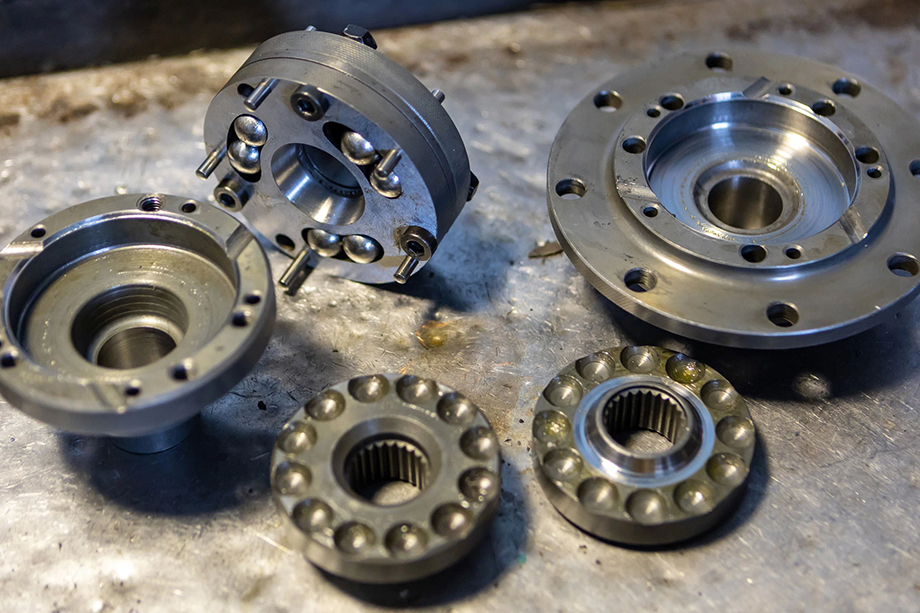
Roller-locking differential
How a roller-locking differential works
When moving in a straight line, the forces on the axle shafts are the same, and there is no mutual movement of the parts. The torque from the central disk, through the chains of balls, is transmitted to both axle shafts.
When the car turns, the wheels on one side start to spin faster. This causes the balls to move in their channels, and the speed of rotation of the axle shafts changes.
But if one of the wheels loses traction and starts to skid, the balls stop moving due to the resistance of the second wheel. So they block the entire structure and transmit the same torque to both wheels.
Advantages of this type of differential
Full locking. Unlike the ball-worm differential, this type of differential provides full locking in both forward and reverse motion.
Instant response. The differential is designed so that it locks almost immediately as soon as one of the wheels starts to slip. Unlocking also occurs immediately when traction is restored.
Fully automatic. In its characteristics, this differential is similar to mechanical locks - but does not require additional communications and manual control.